Q1: Does this in vivo transfection reagent have bone tissue targeting?


There is no targeting. The particles formed by transfection reagents and RNA are at the nanoscale. Our in vivo distribution experiments have found that the RNA levels are the highest in the liver and lungs. This one is now a universal in vivo transfection reagent. The targeted products mentioned earlier are not in stock and need to be customized. Because we need to make chemical modifications. The laboratory has completed the in vivo targeted transfection reagents for tumor tissue, cartilage tissue and bone tissue. Some customers need to customize them, and the target heads of the three types are different. Cartilage targeting is to target chondrocytes. Bone targeting is to target osteoblasts
Q2: Must the RNA used be purified by PAGE and HPLC? Are there other purification methods for siRNA and miRNA?
Must the RNA used be purified by PAGE and HPLC? Are there other purification methods for siRNA and miRNA?
Q3: Must the RNA used be purified by PAGE and HPLC methods? Are there any other purification methods for siRNA and miRNA?
Must the RNA used be purified by PAGE and HPLC methods? Are there any other purification methods for siRNA and miRNA?
Q4: Are the purification methods for siRNA and miRNA different from mRNA purification?
Are the purification methods for siRNA and miRNA different from mRNA purification?
Q5: Are the purification methods of siRNA and miRNA different from those of mRNA?
Are the purification methods of siRNA and miRNA different from those of mRNA?
Q6: Can the RNA and transfection reagent complex be diluted with other reagents?
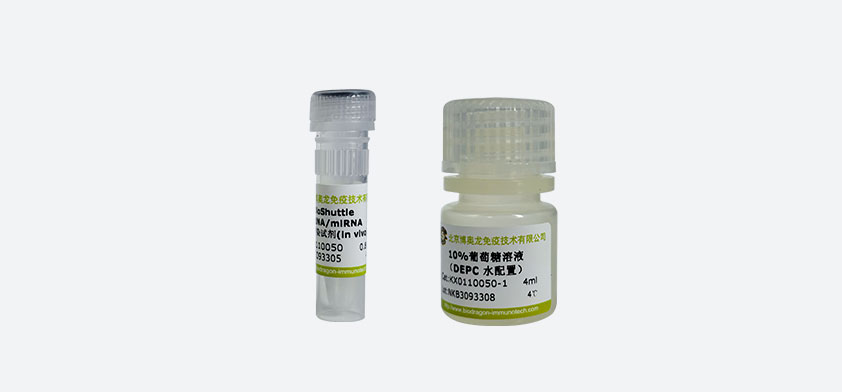
It is recommended to use the isotonic solution tested in the laboratory (5% glucose solution prepared with DEPC sterile water) to prepare the RNA and transfection reagent complex. If other solutions need to be tried, DEPC sterile water or serum-free medium can be tested. However, the results were more stable when 5% glucose solution (w/v, prepared with sterile DEPC water) was selected.
Q7: Can the RNA and transfection reagent complex be diluted with other reagents?
Can the RNA and transfection reagent complex be diluted with other reagents?
Q8: Why is glucose solution needed for dilution? To reduce injection volume, can the glucose diluent be omitted?
Why is glucose solution needed for dilution? To reduce injection volume, can the glucose diluent be omitted?
Q9: May I ask why glucose solution is needed for dilution? Can glucose diluent be omitted to reduce the injection volume?
May I ask why glucose solution is needed for dilution? Can glucose diluent be omitted to reduce the injection volume?
Q10: Can both RNA transfection reagents be used for RNA and DNA co-transfection?
Can both RNA transfection reagents be used for RNA and DNA co-transfection?
Q11: What is the difference between the [RNA In Vitro Transfection Reagent] and the [RNA In Vivo Transfection Reagent]?
What is the difference between the [RNA In Vitro Transfection Reagent] and the [RNA In Vivo Transfection Reagent]?
Q12: What are the differences between "RNA in vitro transfection reagents" and "RNA in vivo transfection reagents"?
What are the differences between "RNA in vitro transfection reagents" and "RNA in vivo transfection reagents"?
Q13: Is your transfection reagent GMP grade?
no
Q14: For the siRNA in vivo transfection reagent, the product Q&A mentions non-targeting, most obvious in lung and liver. The customer's target organ is the spleen. Do you have relevant data for this?
There is no data on the spleen for the time being
Q15: How to verify efficiency?
(Note: It is recommended that regardless of whether precipitation is found or not, the prepared complete culture medium should be fully inoculated and cultured for pre-experiment detection. Usually, the test cells and the complete culture medium should be placed in a 37 ° C incubator overnight for observation.)" "
Q16: What factors affect knockdown efficiency?
① Small RNA sequence design: Efficient knockdown depends on the specificity and stability of small Rnas. ② High-purity RNA is a key factor for successful transfection. The content and purity of RNA should be determined before transfection (OD260/280 > 1.8). ③ Delivery method and dosage: The amount of RNA used should be determined based on the animal model, administration route, and target organ. The recommended proportioning dosage for RNA transfection in rodents is provided in the instruction manual. ④ Target tissues: Some tissues (such as the liver) are more likely to achieve high-knockdown due to their rich blood flow, while others (such as the brain) may require additional optimization.



 Save
Save
 Phone
Phone
 Contact Us
 QQ
QQ
 QR Code
 Scan the QR code