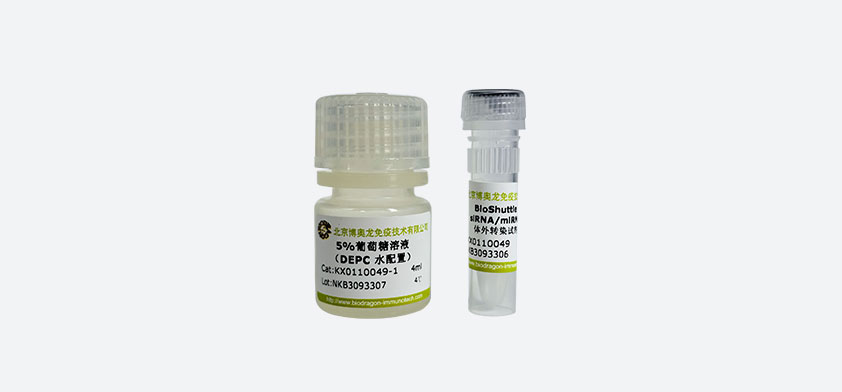
BioShuttle siRNA/miRNA in vitro transfection reagent

GoodsCode: KX0110049
Save
Specs Price Futures Quantity
  • 0.8ml
    300.00
    Ask

Product Informations

  • Goods Code KX0110049
  • Goods Name BioShuttle siRNA/miRNA in vitro transfection reagent
  • Category 525
  • Shipping and Storage Conditions Transported at room temperature, stored at 4°C, stable storage period of 12 months. Long-term storage at -20°C
  • Precautions 注意事项
    1. 转染前细胞应处于对数生长期的良好状态,推荐细胞传代后12-24小时内转染,细胞密度控制在50%-70%
    2. 使用高纯度的RNA也是转染成功的关键因素,在转染前确定RNA的含量和纯度,实验过程中使用DEPC处理过的耗材和试剂,避免RNase污染;另外RNA与转染试剂复合物制备时盐含量高会导致复合物形成时产生沉淀,因此应将RNA重悬于5%葡萄糖溶液(由无菌DEPC水配制)或DEPC水中,如下(4)中推荐的稀释液;
    3. RNA与转染试剂复合物应现配现用;配置后的RNA与转染试剂复合物应于1小时内用于细胞转染;
    4. 体外细胞转染时血清的影响:高浓度血清的存在会影响BioShuttle siRNA/miRNA体外转染试剂与RNA形成复合物。因此推荐转染过程中使用无血清培养基,以达到复合物形成的最佳效果;如细胞对无血清条件完全不能耐受,则推荐转染过程使用不高于3%含量的血清;复合物进入细胞后(约需4-6小时),血清的存在并不影响复合物的转染效果,因此转染4-6小时后可加入含血清培养基继续培养细胞;
    5. 体外细胞转染推荐稀释液: 5%葡萄糖溶液(w/v,用无菌DEPC水配制); BioShuttle siRNA/miRNA体外转染试剂试剂可用该稀释液稀释,稀释后的BioShuttle siRNA/miRNA体外转染试剂试剂置于4-20保存,两周内稳定;
    6. 为了达到更好的转染效果,可根据实验需要优化RNABioShuttle siRNA/miRNA体外转染试剂的配比,推荐优化比例范围为1:2~1:8w/v, RNA: BioShuttle siRNA/miRNA体外转染试剂);
    7. 本产品仅用于科学研究,不用于临床诊断和治疗。
  • Instruction Manual /files/uploads/instructions/2024/202407/KX0110049_BioShuttle siRNAmiRNA体外转染试剂_说明书(1).pdf

Picture

Product Details

Reagent components
Reagent components Specification preservation
BioShuttle siRNA/miRNA in vitro transfection reagent 0.8ml Store at 4℃
5% glucose solution (gift) * 8ml Store at 4℃
* Note: Here, 5% glucose solution (w/v, prepared with DEPC water) is provided as a free gift. If a larger quantity is required, sterile DEPC water can be used for self-preparation.

Product Description
BioShuttle siRNA/miRNA in vitro transfection reagent is a new type of highly efficient cationic polymer. It can interact with RNA (including siRNA and miRNA) to form complexes and deliver RNA into eukaryotic cells. It features high transfection efficiency, low cytotoxicity and good biocompatibility. It is especially suitable for various high-throughput cell screening experiments, being convenient, fast and efficient. After the BioShuttle siRNA/miRNA in vitro transfection reagent enters the cell through endocytosis, it expresses the characteristic of "proton sponge effect", buffering the pH value of the endosome and protecting RNA from degradation. The continuous proton influx can also cause lysosomal osmotic swelling and rupture, providing a mechanism for RNA to escape into the cytoplasm.

Product features
1. High transfection efficiency
2. A wide range of cell types
3. High cell safety


Operation steps
Cell inoculation: Cells were inoculated in well plates 18 to 24 hours before transfection. The cell density and culture medium volume are shown in Table 1
Table 1. Recommended cell inoculation volume and culture medium volume in Commonly used cell culture apparatus
Cell culture device Cell inoculation quantity Volume of culture medium (mL)
96-well plate (0.5-0.8)×104 0.2
24-well plate (2.5-3)×104 0.5
12-hole plate (1-1.5)×105 1
6-hole plate (3-3.5)×105 2
100 mm petri dish (0.8-1)×106 10
 
2. Prepare the RNA-transfection reagent complex
The transfection formula ratios are shown in Tables 2 and 3. Table 2: Taking the final concentration of RNA at 1 nM and the molecular weight of RNA at 14 kDa as an example; Table 3: Taking 1 nM with an RNA molecular weight of 60 kDa as an example.
Dilute X μg of RNA (prepared with DEPC sterile water) to the desired final concentration using a 5% glucose solution prepared with W μL of DEPC sterile water.
Note: Depending on the differences between cells and the target gene, the required final concentration of RNA may range from 1 to 50 nM, with a common reference dose of 20 to 30nM. More accurate data can be obtained through gradient experiments or by referring to relevant experimental references.
2. Immediately add Y μL of the BioShuttle siRNA/miRNA in vitro transfection reagent.
Note: The recommended ratio of RNA to BioShuttle siRNA/miRNA in vitro transfection reagent is a mass-to-volume ratio of 1:2 (w/v, 1 μg of RNA transfected with 2 μL of BioShuttle siRNA/miRNA in vitro transfection reagent).
After thorough mixing, let it stand at room temperature for 20 minutes.
 
Cell transfection
During the formation of the complex, replace the culture medium for the cells prepared in step 1 with a serum-free and bispecific antibiotic-free culture medium (or a 3% serum-free and bispecific antibiotic-free culture medium can also be used). The volume of the added culture medium should be Z mL
2) Add the BioShuttle siRNA/miRNA in vitro transfection reagent and RNA complex prepared in step 2.
3) Incubate at 37 ℃ in a 5% CO2 incubator. After transfection for 24 to 48 hours (no medium change is required during the process, or serum-containing medium can be added 6 hours after transfection depending on the cell type), detection should be carried out by appropriate methods.
Table 2. Dosage of each component used during cell transfection in Common cell culture Apparatus
Cell culture device Final volume of culture medium (mL) X: The amount of RNA added. Take RNA with a molecular weight of 14kD and a final concentration of 1nM as an example Y (μL) : The volume of transfection reagent added W (μL) : Total volume of RNA-transfection reagent complex Z (mL) : Volume of serum-free medium added
96孔板 0.2 2.8 ng (0.2 pmol) 5.6×10⁻³ 40 0.16
24孔板 0.5 7.0 ng (0.5 pmol) 1.4×10⁻² 100 0.4
12孔板 1 14 ng (1 pmol) 2.8×10⁻² 200 0.8
6孔板 2 28 ng (2 pmol) 5.6×10⁻² 200 1.8
100 mm培养皿 10 140 ng (10 pmol) 0.28 500 9.5
Note: The ratios in the table are the amounts required for cell transfection in one well when the final RNA concentration is 1nM. Please adjust the corresponding ratios according to different final RNA concentrations when using

Table 3. Dosage of Each Component Used during Cell Transfection in Common Cell Culture Apparatus (High Molecular Weight RNA)
Cell culture device Final volume of culture medium (mL) X: The amount of RNA added. Take RNA with a molecular weight of 14kD and a final concentration of 1nM as an example Y (μL) : The volume of transfection reagent added W (μL) : Total volume of RNA-transfection reagent complex Z (mL) : Volume of serum-free medium added
96孔板 0.2 12 ng (0.2 pmol) 2.4×10⁻² 40 0.16
24孔板 0.5 30 ng (0.5 pmol) 0.06 100 0.4
12孔板 1 60 ng (1 pmol) 0.12 200 0.8
6孔板 2 120 ng (2 pmol) 0.24 200 1.8
100 mm培养皿 10 600 ng (10 pmol) 1.2 500 9.5
Note: The ratios in the table are the amounts required for cell transfection in one well when the final RNA concentration is 1nM. Please adjust the corresponding ratios according to different final RNA concentrations when using
 

Citation (1)

Q1: Which cells has this transfection reagent been tested on?

Q2: Must the RNA used be purified by PAGE and HPLC? Are there other purification methods for siRNA and miRNA?

Q3: Are the purification methods for siRNA and miRNA different from mRNA purification?

Q4: Can the RNA and transfection reagent complex be diluted with other reagents?

Q5: Why is glucose solution needed for dilution? To reduce injection volume, can the glucose diluent be omitted?

Q6: Can both RNA transfection reagents be used for co-transfection of RNA and DNA?

Q7: What is the difference between the [RNA In Vitro Transfection Reagent] and the [RNA In Vivo Transfection Reagent]?

Q8: Which cells have been tested with this transfection reagent?

Q9: Is your transfection reagent GMP grade?

Recently Viewed Products

If you are interested in our products or services, you can contact us through the following methods

  • In the form below Describe Your Needs
  • Click "Online Consultation" on the right side of the page for quick assistance Quick Tool Consultation
  • Call our toll-free number 400-921-8278
  • Send an email to our mailbox sales@biodragon.cn
« »