Mouse Tissue One-Step Direct Amplification PCR Kit (With Dye)

GoodsCode: BDAG0026
Save
Specs Price Futures Quantity
  • 1ml
    60.00
    Ask
    5ml
    170.00
    Ask

Product Informations

  • Goods Code BDAG0026
  • Goods Name Mouse Tissue One-Step Direct Amplification PCR Kit (With Dye)
  • Category 601
  • Instruction Manual /files/uploads/instructions/2024/202401/BDAG0026_小鼠组织一步法直扩 PCR 试剂盒(With Dye)_说明书.pdf

Picture

Product Details

Item number Specification Number of reactions
BDAG0026-1ml 1ml 100rxn10ul/rxn
 
BDAG0026-5ml 5ml 500rxn10ul/rxn
 

Product Description
This kit contains rapid release reagents for mouse tissue DNA and PCR amplification reagents. It can rapidly release genomic DNA from tissues such as the tail, ears, and toes of mice without the need for nucleic acid extraction. The released products can be directly subjected to PCR amplification, enabling rapid genotyping of mice.
The Mouse Tissue Direct PCR Mix in the kit is a 2× concentration premix reagent, containing Taq DNA Polymerase, Mg2+, dNTP and an optimized buffer. It is easy to operate and reduces the possibility of contamination, enabling high-throughput detection. Just add primers and templates to the reaction system to carry out the PCR reaction. The protective agent added to the system enables the 2×Master Mix to remain highly active after repeated freeze-thaw cycles. The product contains dyes, and the PCR products can be directly subjected to electrophoresis detection.


Product features
1. The kit does not require nucleic acid extraction or purification of mouse tissues; it can directly conduct PCR reactions, saving time and effort
2. Mouse Tissue Lysis Buffer combined with proteinase K can rapidly lyse mouse tissues;
The best effect is achieved when the amplification product is within 2kb.
4. The product contains dyes, and the PCR products can be directly subjected to electrophoresis detection.

Experimental procedure
1. Sample preparation
Cut 1-5mm of the mouse tail (or 3-5mm diameter mouse ears and 2-3 mouse toes).
2. Add 200µL of Mouse Tissue Lysis Buffer and 4µL of Proteinase K to the samples respectively, vortex to mix well, and incubate ina 55 ° C water bath for 30 minutes. After incubation, heat the samples at 95 ° C for 10 minutes.
Note: If a large number of samples are to be processed, Mouse Tissue Lysis Buffer and Proteinase K can be mixed in advance, swirled evenly and set aside for later use.
3. Thoroughly mix the above products by vortex oscillation, then centrifuge at 12,000 RPM for 2 to 5 minutes. Take the supernatant and the PCR reaction can be carried out.

2. Amplification system and conditions
Preparation of the reaction system
Component Volume(µL per sample) Final concentration
Mix A Mix B
2×Mouse Tissue Direct PCR Mix
Forward Primer (10 μM)
Reverse Primer (10 μM)
Template* 
PCR Grade H2O
10
0.5     0.5   
1

To 20
25
1.0          1.0
2.5
To 50

0.25 μM
0.25 μM
/
/
Total volume/rxn 20 50  
*Note: It is recommended that the amount of DNA template added be 5-10% of the total reaction volume
  1. Reaction procedure
Step Temp. Time Cycle
Initial Denaturation 95 2 min 1 Cycle
Denaturation
Annealing*1
Extension*2
Final Extension
95
60
72
72
25 sec
25 sec
1 min
7 min
35~40 Cycles
*Note: *1: The Annealing temperature is set according to the actual annealing temperature (Ta) of the primer.
The extension speed is 30sec/kb, which can be adjusted according to the size of the amplified fragment.
  1. Detection of amplification products
    After PCR amplification is completed, the product can be directly detected by agarose gel electrophoresis.

    Application Examples
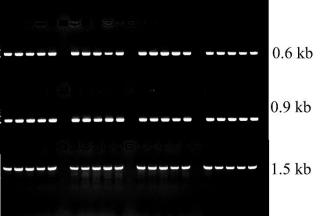
    This kit was used to detect genes of different fragment sizes in mouse tails, and amplification was all accomplished well.


Precautions
1. The thawing of PCR Mix needs to be carried out on ice and avoid repeated freezing and thawing.
2. The PCR reaction preparation process should be carried out on ice. After adding all the components, please briefly vortex to mix well and then centrifuge.
3. The inactivation step of Proteinase K is indispensable in the sample preparation stage.
4. Please avoid nuclease contamination of the sample, otherwise it may cause difficulties in the amplification reaction.
5. Please read this instruction carefully and use this product strictly in accordance with the operation procedures and the recommended dosage.

Citation (0)

Q1: Can this tissue direct amplification kit be used for mouse cell samples?

Related Products

Content is folded

Recently Viewed Products

If you are interested in our products or services, you can contact us through the following methods

  • In the form below Describe Your Needs
  • Click "Online Consultation" on the right side of the page for quick assistance Quick Tool Consultation
  • Call our toll-free number 400-921-8278
  • Send an email to our mailbox sales@biodragon.cn
« »