Cyclic Adenosine Monophosphate (cAMP) ELISA Detection Kit
| Item number |
Specification |
| BDEL-0401 |
96T |
In 1958, Sutherland discovered cAMP (Adenosine 3', 5'-cyclic monophosphate) and was awarded the Nobel Prize in Physiology or Medicine in 1971 for this discovery. In 1963, Ashman discovered cGMP (Guanosine 3 ',5 '-cyclic monophosphate). Both cAMP and cGMP are small cyclic nucleotides that exist in trace amounts in animal, plant cells and microorganisms, and are called the second messengers within cells (hormones are the first messengers). cAMP (or cGMP) is produced by adenylate (or guanylate) cyclase and degraded by phosphodiesterase. Therefore, activating adenylate (or guanylate) cyclase or inhibiting phosphodiesterase can increase the content of cAMP (or cGMP) within cells. Research has found that inhibitors of cAMP (or cGMP) -specific phosphodiesterase can be used in the treatment of human diseases. For instance, the blocker that enhances β -adrenergic receptors (cAMP) has been used for heart diseases such as arrhythmia, hypertension, and myocardial infarction. Clinical trials for the inhibitor of camp-specific phosphodiesterase 2/4 are currently underway in terms of cognitive enhancement. Cgmp-specific phosphodiesterase type 5 can be used to treat diseases such as ED. In drug screening studies, to find suitable adenosine monophosphate (or guanosine monophosphate) cyclic enzyme activators or phosphodiesterase inhibitors, a highly sensitive and specific cAMP (or cGMP) concentration detection method is required.
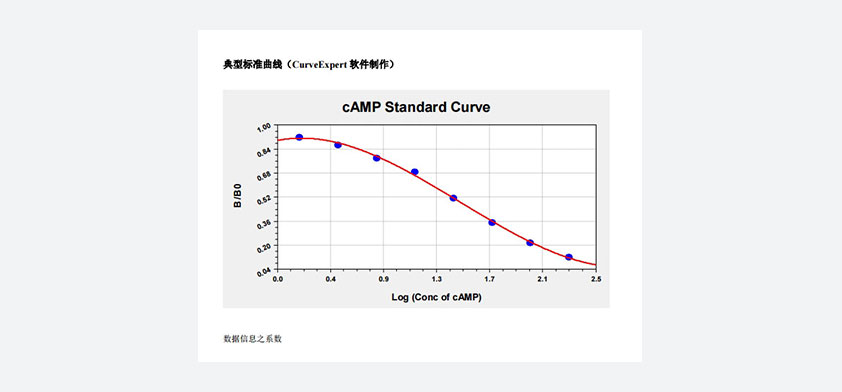
The principle of this ELISA kit is the competitive competition between HRP-cAMP and free cAMP for the limited antigen binding sites of cAMP mAb. Since the HRP-cAMP content is constant, while the free cAMP (cAMP in the sample) content is uncertain. After cAMP monoclonal antibody binds to free cAMP in the sample, its ability to bind to HRP-cAMP is inversely proportional to the content of free cAMP. The goat anti-mouse IgG that has been coated on the well plate in advance, when the above antigen-antibody complex is captured and the content of HRP-AMP bound to the well plate is measured, the content of cAMP in the sample can be calculated. This ELISA kit has an IC50 (50% B/B0) of approximately 12 pmol/mL and a detection limit (90% B/B0) of approximately 0.15 pmol/mL.
Competitive ELISA standard Curve preparation method (Curve Expert software)



 Save
Save

 Phone
Phone
 Contact Us
 QQ
QQ
 QR Code
 Scan the QR code